Tuesday, September 2, 2014

Gorby, Staged and Upstaged

(Photo: Dennis Paquin / Reuters)

This November the world will celebrate the 25th anniversary of the fall of the Berlin Wall, an event which at the time seemed to herald a new era of freedom, not only for millions of people in East Germany but throughout the Soviet-dominated Eastern European bloc and, indeed, in the Soviet Union itself.  "Mr. Gorbachev, tear down this wall!" Ronald Reagan famously demanded in his speech in the still-divided Berlin in 1987, and while Gorbachev didn't exactly tear it down -- there were countless volunteers more than happy to do the job -- he didn't send in Soviet troops to stop it from coming down, as previous Soviet leaders most assuredly would have done.  
Mikhail Gorbachev, it was widely assumed, was something different -- somewhat.  "This is a man we can do business with," British Prime Minister Margaret Thatcher said in her best British shopkeeper daughter's voice not long after Gorbachev became the General Secretary of the Communist Party of the Soviet Union in 1985 (his title was thankfully shortened to simply "President of the Soviet Union" in 1990).  The newspapers at the time dubbed him "Gorby," though the predictably non-conformist New Republic preferred to call him "Gorbo."  That moniker never caught on, probably because its reference to the reclusive film star was so off the mark.  Gorbachev unlike Garbo in her post-film career years, was everywhere in the 1980s and early '90s.  His speeches, policies, his 1987 book  Perestroika (restructuring) with its call for greater freedom and openness (glasnost) in the stultified, stratified, economically stagnant Soviet Union, and the signature large birthmark adorning his bald pate (resembling either the Korean Peninsula or the Siberian archipelago of islands known as Durak Aprel, depending on who you ask), all were as ubiquitous as Stalin and his pipe were in the 1930s and '40s.  Gorbachev seems to have never questioned the basic system Lenin had created, but thought he could "reform" it without destroying it -- a claim that was more PR than political reality -- and his annoucement that he possessed the magic formula to square the circle, i.e., produce freedom in a society structured from top to bottom expressly to deny freedom, brought praise from the more gullible sectors of the West (remember those journalists who regularly experienced "Gorbasms?") as well as attacks from his political enemies at home.  Those attacks reached critical mass in August of 1991.  They're also the subject of The President's Holiday, a play by British playwright Penny Gold, which opened at the Hampstead Theatre in London in 2008 but has not, to my knowledge, been performed yet in the United States.  

Peasant Chic

The play's cleverly begins by showing us Gorbachev's wife Raisa -- an educated, stylish academic, far removed from the stout babushkas of previous Soviet leaders' spouses -- playing the role of doting grandmother as she fits an old peasant dress for her granddaughter.  The nine-year-old tells her grandmother, "Mummy said it's very old."
RAISA:  These bits are.  (She points to various panels.)  The embroidery.  An old lady gave them to me when I visited her village.  She made them herself.
NASTENKA:  Was she a witch?
RAISA:  Of course not.  But she was very old and she sewed all those stitches when she was just a little girl.  And now she wants someone else to have it and to enjoy it, to keep the tradition going.  So she gave it to me, for you.
That peasant dress, for playwright Gold, encapsulates the situation she sees Gorbachev and Raisa embroiled in.  They're both educated, "modern" people, partners in crime, eager modernize the doddering Soviet Union which has by this time become an economic basketcase.  But Raisa's attitude toward the patchwork dress is meant to signal to us that the Gorbachev's are also respectful of Russian tradition (if not, in real-life, terribly respectful of their captive republics' traditions, or even the traditions of Russia's own citizens).  Modernizing a moribund police-state will turn out to be somewhat more difficult than fitting an old peasant dress to the body of a little girl.

Dialectics as Dialogue

The entire play takes place during the pivotal weekend of August 18-21, 1991, when Gorbachev and his family -- his wife, his doctor-daughter Irina, her husband Anatoly, and their two young daughters -- are vacationing at the Presidential  dacha on the Black Sea.  Gorbachev is at work on an important speech he plans to give in Moscow in a few days, one which will grant some freedom for the various republics under Soviet control to choose their own leaders, but still not allowed to choose freedom from Soviet rule.  In the midst of this summer idyll, fate as it tends to do, steps in.  A national "State of Emergency" is issued in Moscow by an eight-man committee of Politburo hardliners who have had enough of Gorbachev's reforms.  They see chaos and uncontrollable flora springing up in the formerly well-pruned Soviet garden, and they aim to nip it in the bud.  Their statement tells the world that the President "due to reasons of health" is "incapable of carrying out his duties," and that Vice President Yanayev has assumed the Presidency.  The coup is underway.

Meanwhile, the 60-year-old Gorbachev and his family have been put under house arrest in their dacha, including a large phalanx of guards preventing anyone from coming or going into or out of the compound, a blockade from the sea, and all telephone, television, and radio communications cut off.  Even Gorbachev's longtime friend and personal KGB security guard Yuri Plekhanov has turned against him and sided with the coup.  Gorbachev and his family are utterly isolated from the world, with the very real possibility that they'll all be shot if he does not accept the coup's demands.  The situation is not unlike the family headed by Fredric March in the 1950s William Wyler film The Desperate Hours, who are kept hostage by Humphrey Bogart and his group of escaped convicts, with the exception that Gorbachev is not a simple suburban family man, and nearly everyone in this play talks incessantly about Marxist ideology.  That minor quibble aside, those discussions provide the few ideas, if one can call them ideas, that the play offers.  The sharp confrontations between Gorbachev and Plekhanov recur throughout the play, ratcheting up the suspense with each encounter primarily because since this particular debate may be settled by an execution.
MIKHAIL:  You are an officer of the KGB.  I respect the KGB.  I have worked with them --- not because I like men in black mackintoshes trailing innocent citizens, but because I hate corruption and I want to stamp it out.  To make our country decent again --
PLEKHANOV:  Do you think I don't?
MIKHAIL (silencing him with a look):  I want a place where ordinary people work hard and can be open and honest and not one where it's easier to keep quiet and do nothing because every effort you make is thwarted by a bureaucracy worse than Byzantium.  I want one where we work together, not one run by fat officials who watch you wade through the mud because the road money is in their own pocket.  Like the housing money, and the tractor money, and the fuel money.  I want to make things better for people.  And I thought you did too.  I thought we shared a vision.
The Human Soul:  An Owner's Manual

Was Gorbachev really so naive as to think that corruption could be eliminated from the Soviet Union while preserving its basic economic and political structure?  Historians are still arguing about the precise degree of idealism and opportunism in Gorbachev's so-called reformist agenda The play adamantly portrays Gorbachev as a man who was genuinely sincere in his belief that communism could be reformed not only from within but from the top-down, and that ordinary people could be given "the freedom to make some of their own decisions, run their own affairs."  It was not an entirely implausible goal.  After all, the Chinese had already been achieving some success with allowing capitalism to operate within the People's Republic, though its oppressive state still denies individuals basic freedoms of speech and protest, as the mass butchery in Tiananmen Square -- which also took place in 1989, the year of the Berlin Wall's fall -- horribly demonstrated.  But Gorbachev is no capitalist; the play asks us to believe that Lenin's massive slave state could have been administered without coercion and terror to create a better, freer, fairer society than the ones in the West:
GORBACHEV:  Because capitalism is about greed.  That's what it's built on.  Our state's not like that and never will be.  We know we're not here just for ourselves, for egotism, for me.  We have a sense of something beyond us.  That's socialism.  We serve.  Until capitalism, everyone did that -- once it was a god, or the kind or the czar -- even the old feudal lords something nobler than their own pockets, even the boyars for God's sake, knew more than the bankers!  "I will not serve!," wasn't that what the devil said?  Because we have no gods here any more, some people think we're devils, but we're not -- we leave that to the West!  Now, here, with us, we serve the people, the common good, each other.  That's what I believe in, it's what I'm trying to do. It means more to me than anything and it comes from the soul.  I've seen more joy in the faces of people that serve and give and share than I've ever seen on the face of some rich American in the West with a big car.
Of course, one can respond that it should be nobody's business if a person prefers to use the money he's earned to buy a big car rather than "serve" a czar or feudal lord or "the people."  And communist societies have invariably shown that the only way you can make people put aside their "greed" -- which can also be considered simply enlightened or even unenlightened self-interest -- is for the state to force them to be "good," while the party elite gets to behave in any way they wish.  The state then becomes "the engineer of human souls" (to borrow the title from the Czech writer Josef Skvorecky's 1985 novel); and yet, humans being human, the engineers are unsurprisingly inclined to indulge themselves in those big cars and other luxuries they imperiously deny the citizens, who must do most of the "sharing" and "serving."  Who, then, will watch the watchmen?  How do you stop corruption in a state which, by definition, is run by a ruling class of professional revolutionaries -- the so-called "Dictatorship of the Proletariat" -- apparatchiks who can't be voted out of power or even criticized, since the Party controls the entire apparatus of news on television, radio, and all publications?  Would Gorbachev have really loosened up the controls of the system and allowed greater freedom of the press so that dissidents could criticize even him?  Could the major domos of the Party elite been brought to heel through stricter regulations and oversight?  Could Marxism-Leninism actually become free and democratic?  More importantly, did Gorbachev ever actually himself believe or desire for it be so?  I leave this question to the historians and political scientists to sort out.

We never get to find out (though some of us already strongly suspected the answer) because although Gorbachev and his family, as we know, were never shot, his presidency was effectively ended during that tense weekend in the dacha on the Black Sea.  (The play presents short audio segments performed in darkness between the main scenes, in which we hear voices of a family under house arrest who eventually are shot.  It takes a while before we learn that the voices in these brief interludes -- called "Echoes" in the script -- belong to Tsar Nicholas II, his wife Alexandria, and their children, who are being prisoners by the Bolsheviks in the basement of a house in Yekaterinberg in 1918.  The play insists on a similarity between the plight of the two families, particularly when the sounds of gunfire from old Russian rifles shooting the royal family merge with the sound of modern guns firing on Soviet crowds during the demonstrations in Moscow in 1991.)  Ultimately the Kremlin coup fails and is supplanted by Boris Yeltsin, the man of the hour, who stands on a car with a bullhorn denouncing the plotters and eventually replaces Gorbachev as President of the Soviet Union and then simply President of Russia, shorn of its many satellite republics.  The old Soviet Union that Gorbachev hoped to preserve was, after 75 years, deader than a Soviet-made doornail.

The Family That Made It to Moscow

It would be a mischaracterization of the play to suggest that it's all speechifying and politics.  Many scenes deal with the spectacle of a man struggling to keep both his family calm intact in the midst of a terrifying ordeal.  With the help of his pessimistic but resourceful son-in-law Anatoly, Gorbachev uses a camcorder to record a statement for the world in which he condemns the Kremlin coup in no uncertain terms; he records it four times, and then hides the four strips of videotape throughout the dacha, even lining a window curtain with one.  Raisa finds an old Sony transistor radio from which they glean news of the outside world from -- where else? -- the BBC World Service.  When the stress of the three days under house arrest prove too much for Raisa and she collapses with nervous exhaustion, her doctor-daughter helps her recover, though Irina's own nerves are frayed to the limits as she tries to create a "normal" atmosphere for her two daughters, playing games with them and making sure they're locked in the bedroom upstairs whenever the coup's guards enter the house.  At times the events turn comic, as the Supreme Leader of the Soviet Union is doggedly trying to keep together not merely his presidency but his own unruly family.  Gold's makes a special effort to capture the worry, doubt, resolve, tenderness, and fortitude of the women of the play, though this tends to have the unhappy effect of reminding us that she is not Chekhov (though, like the characters of Chekhov's Three Sisters, they all want "to go to Moscow" -- or, rather, go back to Moscow.  Gorbachev for his part makes it plain to his captors that he does not countenance their actions, and insists that all communications be restored along with his presidential authority.  It's a long standoff and no one is giving an inch.  Even though we know Gorbachev and family would ultimately survive to return to Moscow, there are moments when we feel that any minute it might all be over for them.  (Some of the original British reviewers of the play ardently wished that the play was over long before that.)

A final scene set months later sums up the events following the failed coup.  As we all know, Yeltsin -- whom Raisa calls "a selfish, dangerous drunk only out for himself" -- disbanded the Soviet Union and, with the help of Western advisers, ushered in a "shock therapy" program of rapid conversion to capitalism which freed millions of countries from Soviet domination but also helped create Russian billionaires  while leaving many other Russian citizens feeling adrift.  Today some economics and political scientists believe that a sudden transition to capitalism without an independent civic society of the kind which  took centuries to develop in the West, was most likely a misstep.  But consider:  no large communist society had ever made the overnight switch to capitalism before, and there were no guidelines to work from.  Amazingly, it was a counter-revolution without bloodshed, but the resulting chaos and rise of dictatorial arch-Russian nationalist Vladimir Putin has created more than enough grief to go around.  Gorbachev, absent Raisa, who died in 1999, lives on, condemning Putin's actions in the Ukraine and, no doubt, continuing to wonder if it could all have been different.  Indeed it could:  The coup might have succeeded, and the Soviet Union with all its manifold horrors might still be with us.  Or Gobachev could still be in power, still mesmerizing Western journalists with happy-talk about "openness" and "reform" with the same dreadful system remaining intact.

"The Past is Never Dead.  It Isn't Even Past."

Playwright Penny Gold has another view -- she tips her hand in the brief introduction to her play.  She writes:
In the 1990s, Reaganites claimed they had "won" the Cold War and Dr. Francis Fukuyama declared "the end of History."  At the time of writing, the American "neocons" continue to assert that with their economic and military might, the triumph of global capitalism is inevitable.  Socialism, they say, is dead.  Well, we'll see.
Clearly Penny Gold still believes in Gorbachev's stated "vision" of a free, noncoercive, unselfish yet efficient socialism in which people would "gladly serve and share" rather than drive around in big cars.  She is one of the last True Believers.  Reagan (along with his neoconservative supporters) was not alone in winning the Cold War -- he had help from Margaret Thatcher, the Pope, Lech Walesa and Polish Solidarity, as well as the inadvertent cooperation from Gorbachev and thereafter Boris Yeltsin.  Even Gorbachev wrote in his memoirs that Reagan's stubborn insistence on maintaining the right to continue researching the Strategic Defense Initiative (SDI), or "Star Wars," as its opponents dubbed it, was crucial in convincing him and his advisers that the Soviet Union could no longer compete militarily with America in the increasingly high-tech arms race.  History may not have "ended," pace Francis Fukuyama -- the ever-growing threat of Islamic jihadists who do not accept Western liberal capitalism as the final stage of history is ample proof of that -- but a particularly bloody chapter of the 20th-century did end in 1991 during those anxious days and nights in the dacha on the Black Sea.  

The President's Holiday tries to convince us that Gorbachev was a fundamentally decent, admirable man, not the leader of the Soviet Union with all that that implied.  To say that he was a better man than Stalin or even Vladimir Putin is to damn with faint praise.  Perhaps Gorbachev was and is a doting father and grandfather -- so what?  The play would have been far better if it could have found a way to present that other, darker Gorbachev, incorporating it into this misleadingly warm "family" drama to create a fuller, truer portrait of the man and the occasion.  But Penny Gold would doubtless not have been interested in writing such a play.  So what we are left with is a protagonist who is less a hero than a helpless bystander, in a play that is a minor footnote to the real-life drama which brought down the curtain on nearly a century of unimaginable but amply documented tyranny.

Sunday, August 17, 2014

Browbeaten

     (Photo: Life, 1949) 

A new "battle of the brows" has been taking place in the pages of the New York Times Sunday Book Review during the past few weeks.  On July 29th, Thomas Mallon and Pankaj Mishra entered the ring with two pieces jointly titled "Highbrow, Lowbrow, Middlebrow -- Do These Kinds of Cultural Categories Mean Anything Anymore?"  For his part, Mallon realizes that the digital democracy we now live in makes those old cultural distinctions more archaic than ever.  (He helpfully points out that the term "highbrow" came into popular use in 1902 by a New York Sun Reporter named Will Irvin, based on the then-faddish science of phrenology, which judged a person's intelligence by the height of his or her forehead; naturally the one with the highest brow was the most intelligent, a theory which Mallon notes has "a certain whiff of racialism and eugenics," which alone should make the term highbrow a no-no in today's more enlightened culture.)  

But the categories of highbrow, lowbrow, and -- most detested by intellectuals for decades  -- middlebrow, no longer exist, as people of diverse cultural backgrounds routinely mix and match YouTube clips, sreaming videos, instragrams, Facebook updates, "reality" TV shows (you'll never see an ostensibly "thoughtful" piece about it without the inevitable quotes around "reality"), pseudo-serious "fact-based" documentaries, the occasional Kindle downloaded -- no pun intended -- with Fifty Shades of Grey, or the latest Malcolm Gladwell opus, "funny" pictures mocking the celebrity du jour, endless quizes testing whether or not you're a great lover, loner, or loafer, (and yes, blogs), along with iPods loaded up with music of every imaginable kind, each haphazard consumer guided purely by their whims, certainly not any hierarchies of taste.  Could there possibly be room for War and Peace in the midst of this cacophony of images and noise?  (Fear not:  Harvey Weinstein is producing a 6-part TV-miniseries of Tolstoy's novel to be aired in 2015.  But will our distracted age watch 6 hours of fictional 18th-century French aristocrats at war and play?)  Mallon,  as befits a novelist  and critic of undeniable stature, nevertheless calls for maintaining serious distinctions within the realm of criticism while accepting that we live in a rowdy, often vulgar democracy.  But can an aristocracy of critical thought coexist with a leveling political democracy?  Nearly two hundred years ago, Alexis de Tocqueville expressed his doubts, seeing the American experiment in democracy the template for the future of the rest of the world.  He predicted that democracy will produce many writers of talent, but few if any of genius.  Today, even the word genius has a whiff of politically incorrect elitism .

No Awakening from the Nightmare of Modernism

Meanwhile, Pankaj Mishra laments that the high Modernism of the early 20th-century, celebrated by anyone with intellectual pretensions at the time, has resulted in another kind of leveling -- the widespread, relentless, often brutal wiping out of indigenous cultures all around the world; folk songs are replaced by mass-produced pop songs, villages are bulldozed to create sterile highrise apartments, national literatures are gradually supplanted by American TV shows or local imitations of them that are even worse.  The modernist dream of intellectual elites has become the default mode of cultural exchange; today, modernism doesn't mean Kafka and Jackson Pollock, but the high-tech entertainments, buildings, and news-presentations whipped up by the graduates of elite universities (with some help from talented if educated singers, actors, and assorted celebrities) for consumption by the working-class and increasingly declasse middle-class, while the elites themselves are too busy making money to worry about acquiring any serious culture at all. (I've heard more than one doctor, lawyer, and successful professional virtually boast to me that they haven't had "time" to read a book for pleasure since they were in college.  And how many students today read books for pleasure even while in college?)  For Pankaj, our ancestors' dream of modernism has become our nightmare of modernity.

The match continued in the August 1st issue of the Book Review, as A. O, Scott weighed in with "The Squeeze on the Middlebrow: A Resurgence in Inequality and Its Effects on Culture."  For him, the loathsome "middlebrow" culture of the American 1950s seems like a Golden Age in retrospect.  Yet at the time, he observes, intellectuals like Dwight Macdonald denounced what he called "midcult" (from his celebrated essay, "Masscult and Midcult") -- he saw it as an easy way for an expanding middle-class to "acquire" culture without the hard work of actually reading difficult books or grappling with challenging, serious art.  For Macdonald, midcult included Hemingway's Spanish Civil War novel, For Whom the Bells Tolls; the "Book-of-the-Millennium Club" (sic); the Revised Standard Version of the Bible; and Mortimer Adler's Great Books program, to name just four particularly egregious examples.  (Macdonald had particular scorn for the "Syntopicon" volume which came with the set of Great Books -- it meticulously listed where every mention of concepts such as "liberty," "justice," "beauty," "equality," and so on appeared in everyone from Homer to Freud.  Pages numbers for each reference included.)  Macdonald, like Virginia Woolf, had a grudging respect for honest "lowbrow" culture which made no pretensions to offering anything but mindless pleasure; in fact, Woolf saw a kind of virtuous alliance between highbrow aristocrats with working-class lowbrows doing an end-run around the vulgar, grasping, and ever-striving middlebrow middle class.  Here we see the origins, or at at least a striking instance, of radical chic at its self-regarding best.

Keeping Up with the Ernest Joneses

Scott cites Thomas Picketty's "surprise" bestseller Capital in the 21st Century -- journalists are always surprised when a "deep-thought" book becomes a bestseller, though it happens regularly every few years; remember Allan Bloom's The Closing of the American Mind? -- as evidence that the shrinking middle-class is helping to shrink whatever's left of middlebrow culture; and more's the pity, says Scott.  Yes, the categories of high, low, and middle that became so prevalent after the Second World War were, in part, marketing tools -- it helps to know the audience you're trying to sell to -- as well as "markers" for people quickly rising up the economic, social, and cultural ladders.  The car you drove, the books you read (or at least had on your shelf), the plays or musicals you saw, the music you listened to, the stuff you hung on your walls (we're assuming you had walls), all served to show where you were in the great pecking order of postwar American life.  The ability to talk about the latest "serious" bestseller -- David Riesman's The Lonely Crowd, let's say -- showed you were a person of education and taste, just as being able to toss off some references to Thomas Picketty's new book at a cocktail party today may gain you brownie points among your new friends.  (See -- some things never change.)  But Scott is not a Virginia Woolf or Dwight Macdonald aesthetic snob.  He's a fine film critic who recognizes that the vanished middlebrow culture also represented genuine efforts by Americans to "better" themselves, to partake of the riches of a culture which has been heretofore reserved only to those with wealth and leisure time.  All those Signet paperbacks of the classics weren't just to impress the neighbors -- they were way stations for millions of people to appreciate writers and thinkers whose works were previously available in expensive hardcover editions for the happy few.  The thought of a very large happy middle-class happy sent shivers of horror down the refined spines of Woolf and Macdonald.

Scott rightly laments the disappearance of the middlebrow film from the Hollywood studios.  Such films were hardly Hiroshima, Mon Amour, but a great many of them had strong scripts, plausible characters, superb acting, and visual pleasures more subtle than the CGI effects of the blockbusters churned out nowadays.  While the vast middle of films -- as well as books, theater, and TV -- has dropped out of the equation, the high (represented by independent films designed for niche audiences) and low (check out what's playing at your multiplex cinema tonight) have  remained, for the most part, the two available options.  One could argue that such movies as the "prestige" films produced by the aforementioned Harvey Weinstein like The King's Speech demonstrate that middlebrow is alive and well, but such films, regardless of well they may or may not be, are a very tiny piece of a very large high/low pie.  And as Scott suggests, even arguing about whether a film or book is highbrow, middlebrow, or lowbrow, would be inconceivable to young culture consumers today, who blithely mix and morph and post and tweet snippets from everything to everyone, all day long.  Conversations about what's highbrow and what's lowbrow are what their parents or grandparents had during college bull sessions -- at least those of their grandparents who went to college.  Today, going to college isn't even middlebrow anymore -- it's become a virtual luxury item.

Middlebrowism Reconsidered

Scott is not the only one who regrets the middlebrow boom of the postwar years.  Recently Commentary magazine published a piece by Michael J. Lewis, "How This Magazine Wronged Herman Wouk," which essentially apologized to the perhaps-archetypal middlebrow writer of the 1950s to 1970s and reassessed his entire career, this time acknowledging his genuine novelistic gifts and regretting that the magazine had slighted him for not measuring up to the modernist writers then in vogue among the literary intelligentsia.  Wouk is still going strong at age 99, and working on a new book.  Perhaps those neglected middlebrows have more staying power than anyone suspected.  (Ironically, Wouk's  last novel, The Lawgiver (2012), with its interweaving of emails, text messages, snippets of screenplay, transcripts of conference calls, and even snail mail, to tell the story of the production of a film about Moses, was even described by some critics as -- wait for it -- "postmodern."

A personal note:  I recall from my publishing days a distinction that senior editors made about bad books.  They were either "junk" or "trash," and while junk could be good fun, trash was not worth wasting your time reading (except as part of the job, so that it could be sold to those lesser folks who actually enjoyed trash).  In the late 1960s, film critic Pauline Kael published her famous 1969 Harper's essay, "Trash, Art, and the Movies," in which she celebrated trash, was suspicious of art (arty movies, at any rate), and rejoiced that movies were a form that was ecstatically "beyond" both trash and art.  All of this now sounds so old and quaint.  No wonder A. O. Scott is nostalgic.  We're drowning in the vast, undifferentiated culture bog, as it becomes increasingly clear that the only kind of status that really impresses anyone these days is not cultural or even social.  It's just having money.  Lots of it.  Nobrow* is the only brow that's left.

*From Lowbrow to Nobrow is actually the name of a book by Peter Swirksi, published in 2005.

Monday, August 4, 2014

Exceptional? Or "Indispensable"?

(Painting: "Spirit of America," Norman Rockwell, 1979)


On Friday afternoon, CNN reported that, during his press conference at the White House earlier that day, President Obama declared that America is "indispensable" to the world in such crises as the current ones in the Middle East because "we're willing to plunge in and try where other countries don't bother trying." 

This may come as something of a surprise to those who remember Obama's view of "American exceptionalism" as something he, well, took exception to; who remember him saying at the NATO summit in France last year that "I believe in American exceptionalism, just as I suspect that the Brits believe in British exceptionalism and the Greeks believe in Greek exceptionalism," and other occasions when he seemed to play down or dismiss the "myth of American exceptionalism.  Certainly many liberals, leftists, and Obama supporters have voiced the same disbelief in a uniquely American exceptionalism, and in fact many essays on the pervasiveness of this "myth" have been penned by fierce critics of the idea, who worry that it breeds chauvinism and an attitude that "America doesn't have to play by the same rules" as other nations. So Obama's recent comments may cause some to wonder: Is there a difference between being "indispensable" and being "exceptional'? Is the former word just a softer, more  utilitarian way of expressing the latter?  Is "indispensable" simply a more down-to-earth sounding notion, conjuring up a vision of an America ready to roll up its sleeves and help the world (but only when called-upon), while "exceptional" implies an almost metaphysical sense of entitlement?  Perhaps Obama has been reading James Flexner's 1994 biography of our first president, Washington: The Indispensable Man.  (If being indispensable was good enough for Washington, it must be good enough for America.)   You can be sure the White House speechwriters have mulled this over during more than one brainstorming session.

Actually, Friday wasn't the first time Obama moved away from his previous skepticism about the idea of American exceptionalism. In the video clip above, taken during Obama's speech to the graduating class at West Point in May, he pointedly said, ""America must always lead on the world stage. If we don't, no one else will" And in the final debate of the 2012 presidential campaign, Obama stated "America remains the one indispensable nation, and the world needs a strong America." Needless to say, Obama also told the West Pointers that military action is not always necessary or wise, that we must "act with restraint," and that collective action is preferable to America going it alone; and he added after his debate remark about America's strength the admittedly self-serving comment "and it is stronger now than when I came into office." But Obama has been saying this sort of thing for some time now.  Is it pure politics, a convenient way to wave the flag to get re-elected in 2012 or to get fellow Democrats elected in 2014?  Or has he really come to appreciate that there's something America brings to the table that no other nation does, that it is indeed, exceptional -- or "indispensable,"  If so, it would be a major leap in Obama's thinking -- exceptionalism suggests far more than merely being indispensable ("Jim is an indispensable part of our corporate team.")  Has Obama become -- shut the barn doors, Mabel -- a neoconservative?  Or is his rhetoric, as is the way of politics, a mixture of both?  Skeptics should rightly remain skeptical -- especially of political language.  Time for us all to reread George Orwell's essay, 
"Politics and the English Language."  For the time being, our president has designated America as indispensable, but not inherently exceptional.  At least the Greeks -- not the ancients, but the modern ones -- will be relieved.

In any event, I have no doubt that the debate about American exceptionalism will continue for a long time, not least among those who believe that America is exceptional for its wickedness, not its goodness. I suspect that you, gentle reader, lean towards one or the other. For myself, I'll paraphrase a line from Pauline Kael's famous essay on Orson Welles: "In a less confused world, its glory would be greater than its guilt.

Saturday, August 2, 2014

Bernard-Henri Levy: The Ugly Tide Washing Across Europe

(Photo: Ouest France)

French writer and perennially controversial public intellectual Bernard-Henri Levy brings his usual crystal clarity to the crisis in Gaza. In his July 30th article in the Wall Street Journal, Levy notes the wave of anti-Semitism now washing over Europe, replete with pro-Palestinian protesters shouting "Hamas! Hamas! Jews to the Gas!" -- which vividly shows that the oft-mentioned "distinction" between anti-Semitism and anti-Zionism is, in practice, a distinction without a difference.

In the 1984 film The Little Drummer Girl, based on John Le Carre's novel, there's a scene where Diane Keaton, posing as a recruit to the Palestinian cause, is being "trained" at a Palestinian camp in Southern Lebanon. She's talking to one of the PLO leaders in his cabin, and, as part of her spy act, makes a reference to "those dirty Jews." The PLO leader stops her, raising his hand, saying, "No, listen, we are anti-Zionist, not anti-Semitic." She looks at him with a sly smile and says, "Yeah, right." Then the PLO leader laughs, and Keaton laughs with him. They both know what the real story is.

Levy rightly points out the relative indifference in Europe over the tens of thousands of Syrians murdered by President Assad -- gassed, shot, obliterated -- as well as the 150 children who were used by Hamas to help build the dozens of underground tunnels from Gaza into Israel who died during their construction, buried under the rubble with no one protesting it in the streets of Paris or anywhere else. Levy's credentials on these issues is beyond reproach: he has spoken out against atrocities committed against Arabs in Darfur, Bosnia, and many other places, as well as supported a Palestinian state for the past fifty years. But he also recognizes that Arabs killing Arabs doesn't rouse the world's indignation; it's when Jews kill Arabs, even to defend themselves against a steady onslaught of rockets and tunnel attacks, that the world sits up and takes notice. In the media it's long been a dictum that "Jews are news." As Levy observes, the world sees Arabs killing Arabs as "normal" -- and Arabs killing Jews as business as usual.

Granted, all people of good will and conscience are disturbed by the civilian casualties incurred by the Gazan Palestinians; but responsible journalists have been careful to explain that the large number of such deaths is in no small part due to the Hamas leaders putting their rockets and bombs in precisely the civilian homes, schools, and hospitals where Israeli retaliation will do the most harm. Perhaps the high-minded citizens of the world expect Israelis to live with a constant barrage of rockets, sixty-second windows of time to get into bomb shelters, and the relentless fear of death falling out of the sky, day after day, year after year. No Europeans or Americans, or most anyone else, would consent to live with such daily terror.

What he does not go on to say -- but others will -- is that Europe has carried the overwhelming burden of guilt for the Holocaust for almost 70 years, and some, though not all, have grown weary of it. The polite agreement that anti-Semitism is out-of-bounds in civilized discourse appears to be breaking down. While there are legitimate criticisms of Israel, and many stalwart friends of Israel in Europe and around the world who have valid criticisms of it, it's not hard to discern an anti-Semitism that doesn't even attempt to disguise itself as anti-Zionism in the recent protests. And this is a development entirely welcomed by, and in fact planned by, Hamas. The plight of actual Palestinian citizens is plainly not their concern.

In the 1970s, Levy published Barbarism with a Human Face, which, together with the release of Solzhenitsyn's Gulag Archipelago, dealt a death-blow to the Paris intellectuals' long-running love-affair with Stalinism and the Soviet Union. He was aided in this long overdue awakening by other members of the so-called nouveau philosophes; and it's gratifying to see Levy continuing to fight against religious and political fanaticism in the second decade of the 21st-century. Barbarism periodically has a face-lift, but its visage cannot hide the brutality which remains all-too-familiar to those who have eyes to see.

Friday, August 1, 2014

Walter Winchell Rhumba


A little musical treat for the first Friday of this new venture.  Where else can you find Xavier Cugat's rendition of the Walter Winchell Rhumba?  The bog spews up many an odd item, and perhaps few odder or more delightful than this?  Who's Xavier Cugat, you ask?  Don't ask.  But who's Walter Winchell, you persist?  The knowledgeable among you already know, but for those who don't, here's a fitting anecdote from the end of Winchell's tumultuous life, when he rode uptown to Columbia University during the student demonstrations in 1968 to observe the action firsthand.  Unfortunately an especially nasty cop rudely shoved Winchell (some say he did even worse), and said something to the effect of, "What the hell are you doing here, old timer?"  Winchell's response was characteristic.  "I'm Walter Winchell," he declared stoutly.  The cop was not only unimpressed, but his blank expression indicated he hadn't a clue who Winchell was.  Walter left the scene forlorn, later telling a friend, "What kind of a world is it where someone hasn't heard of Walter Winchell"?
This kind of world, apparently, for even more people now haven't heard of Walter Winchell.  And yet in his heyday -- the 1930s, 40s, and into the 50s -- Winchell was one of the most famous men in America.  Ostensibly he was a gossip columnist, but he was much more than that:  He was the gossip columnist, the man everyone read, the man PR flack went to with a juicy tidbit about some star or would-be star, hoping that Winchell would put it in his column.  Winchell appeared in movies (usually as himself), was the narrator of the 1958 TV series The Untouchableshad a phenomenally successful radio show (anyone of a certain age, and that doesn't include me, will remember his celebrated opening, "Good evening, Mr. and Mrs. America, and all the ships at sea!  Flash!")  And he had a phenomenally unsuccessful TV show later on, when the famous voice was accompanied by an awkward man who "seemed to be screaming at the camera for no good reason," as one observer noted.  Winchell had thought he was King of All Media before Howard Stern claimed the title for himself, but Marshall McLuhan could have told Winchell (if he'd bothered to listen) that the medium is the message and TV just wasn't Winchell's medium.  ("It's called a medium," quipped Fred Allen, another radio man who was immensely famous in his day and nearly forgotten now, "because it's rarely well-done.)  Never mind.  For a longer time than mere mortals deserve, Winchell was read and listened to by virtually every sentient American, and even a few comatose ones as well.  Winchell had a voice that could easily raise the dead.

He'd been a stalwart supporter of FDR during the Depression and World War II, and America loved his take-no-prisoners approach to hitting the Nazis and fascists with everything he had, which was mainly his voice and his column, with its distinctive, breathless ellipses....between his...startling revelations!  But after the war Winchell turned to the new enemy, the Communist threat, and when he loudly supported Senator Joseph McCarthy (and loudly was the only tone Walter knew), he made some new enemies himself among his former fans.  Winchell red-baited with the best of them, going after reds, pinks, fellow travellers, commie dupes, and people he just didn't like.  Winchell must have known his power was fading when the brilliant 1957 film The Sweet Smell of Success was released with a blistering portrayal of a Walter Winchell-ish columnist and radio commentator named "J. J. Hunsecker," chillingly played to perfection by Burt Lancaster, backed up by one of Tony Curtis as an ambitious small-time press agent ready to lick Lancaster's hand and much worse if it would get one of his clients a mention in J. J.'s column.  Here's an exchange between Curtis's Sidney Falco and Lancaster's Hunsecker:

Sidney Falco: Sure, the columnists can't do without us, except our good and great friend J.J. forgets to mention that. You see, we furnish him with items.
J.J. Hunsecker: What, some cheap, gruesome gags?
Sidney Falco: You print 'em, don't ya?
J.J. Hunsecker: Yes, with your clients' names attached. That's the only reason the poor slobs pay you - to see their names in my column all over the world. Now, I make it out, you're doing me a favor?... The day I can't get along without a press agents' handouts, I'll close up shop and move to Alaska, lock, stock, and barrel.

The two actors were in top form, and the fact that neither they nor screenwriter Ernest (North by Northwest) Lehman from his novella, with an assist from Clifford Odets, felt the slightest fear of reprisal from the real Winchell suggests that Walter's days were numbered.  But newspapers themselves were dying out even back then -- New York City used to have at least nine dailies -- and even Winchell's own flagship paper went under in 1963.  Soon gossip columnists like Liz Smith were learning to make nice about celebrities and not be so darn mean.  The whole story is told in full detail in Neal Gabler's definitive biography, Winchell: Gossip, Power, and the Culture of Celebrity, and in fictional form by Michael (DispatchesHerr in his small but searing book, Winchell.  And you can even see the great Stanley Tucci portray Winchell in the 1998 TV movie directed by the late Paul Mazursky, titled (what else?), Winchell.  That's enough to keep you busy this weekend.

For a time, Walter Winchell was indeed King....of something.  Remember him kindly, for he fought the good fight as well as the bad one(s).  As for Xavier Cugat, that's another story.  Let's rumba.

Thursday, July 31, 2014

Theresa Joan Nason 1928 - 2010


My mom died on this day four years ago.  She was never famous, except to me and everyone who loved her, and many people did.  She was that kind of person.  Mom always had time to listen to people, truly listen, and with exceptional empathy and concern for whatever problems they were wrestling with.  Even in her last year, when she was valiantly struggling to cope with the physical difficulties of being on dialysis thrice a week for a quarter-century, she still tried to listen and offer her invariably wise counsel.  She never told people what to do unless they sought her advice; she was acutely aware of her many gifts.

She could easily have become famous in the more mundane sense if she'd wanted to -- she was beautiful enough in her youth to cause more than one person to suggest she take up modeling.  But that world wasn't the world she wanted to be part of.  Still, she came close:  She was a top-notch executive secretary at Macy's and had the responsibility of coordinating the department store's tie-ins with movies that would advertise at the store in those days.  On one noteworthy occasion she was on the set when Macy's was filming scenes for the 1947 classic film Miracle on 34th Street on location in the store.  She babysat Natalie Wood between takes.  She watched the crew spend a whole afternoon filming one shot of some actors walking out of an elevator, take after take after take.  Natalie was a little girl at the time, and probably kept my mom pretty busy.  

She had that unmistakable 1940s glamour, but she was too down-to-earth to seek a modeling or acting career.  Macy's wanted to train her for a full-scale executive position, unusual for women in those days, but my mom wanted to marry my dad and have children instead.  That's what women were "supposed to do" in those days, she later told me.  But my sister and I were the beneficiaries of her talents, which instead of going to a corporation went into raising us.  She was a voracious reader, of both serious books and fun books; she loved theater, and saw all the great plays and musicals on Broadway; she was an avid film-goer -- her favorite star was Gregory Peck -- and she continued to love movies long after the Golden Age of Hollywood was over.  She knew better than some of her film critics that wonderful films are always being made if you just look for them.

Mom was always deeply interested in both politics and sports, and followed both avidly throughout her life.  She was unfailingly shrewd about both.  She considered Harry Truman a great president back when conventional wisdom dismissed him as a bungler, and the wags said "To err is Truman."  She knew better.  When the first news about the Watergate break-in was reported, she immediately sensed it was an operation that came right from the White House; she called in during Bob Grant's long-running New York radio show and said as much, and Grant said, "Have you been out of the country lady?  Do you think Haldeman and Ehrlichman plotted it in a back room in the White House?"  "Yes," my mom said.  History vindicated her on that.  As a Cub Scout den mother, she taught little boys how to swing a bat -- I'm told she had a pretty good swing.  Our house was filled with books about history -- both hers and my dad's -- which I only came to appreciate when I was much older; but her stories about the great historic events that occurred before I was born lit a spark in my imagination and helped turned me into a reader of history myself.  But perhaps most important of all, she stressed the importance of values, of being a decent person, and being kind to others.  I can't say I've been as kind a person as she was, but she gave me a standard to try to live up to.  I'm still trying, and when I remember my mom, whom I loved with all my heart, I make a note to myself to try harder.  I'm sure that everyone who knew her and loved her feels pretty much the same way.

Naked Dinner: Meeting William S. Burroughs

January 2015 marks the fiftieth anniversary of the famed Massachusetts obscenity trial in which the once-scandalous novel "Naked Lunch" by Beat writer William S. Burroughs was ultimately deemed safe enough for the good people of Boston to read.  The anniversary makes me recall the occasion I had dinner with once-notorious author when he was 63 and I was 20.  It was one of those simple encounters that probably meant little him but wound up meeting a lot to me.  And it was entirely legal. 


It happened in 1977, during the spring of my third year at the State University of New York at Purchase.  A classmate of mine from the English Department slipped into the seat next to me in the cafeteria during lunch and said in her best conspiratorial film noir voice, "Hey, William Burroughs is going to be giving a reading from "Naked Lunch" on campus tonight -- my friend Katie's having him over to her apartment for dinner beforehand. Want to come?" 

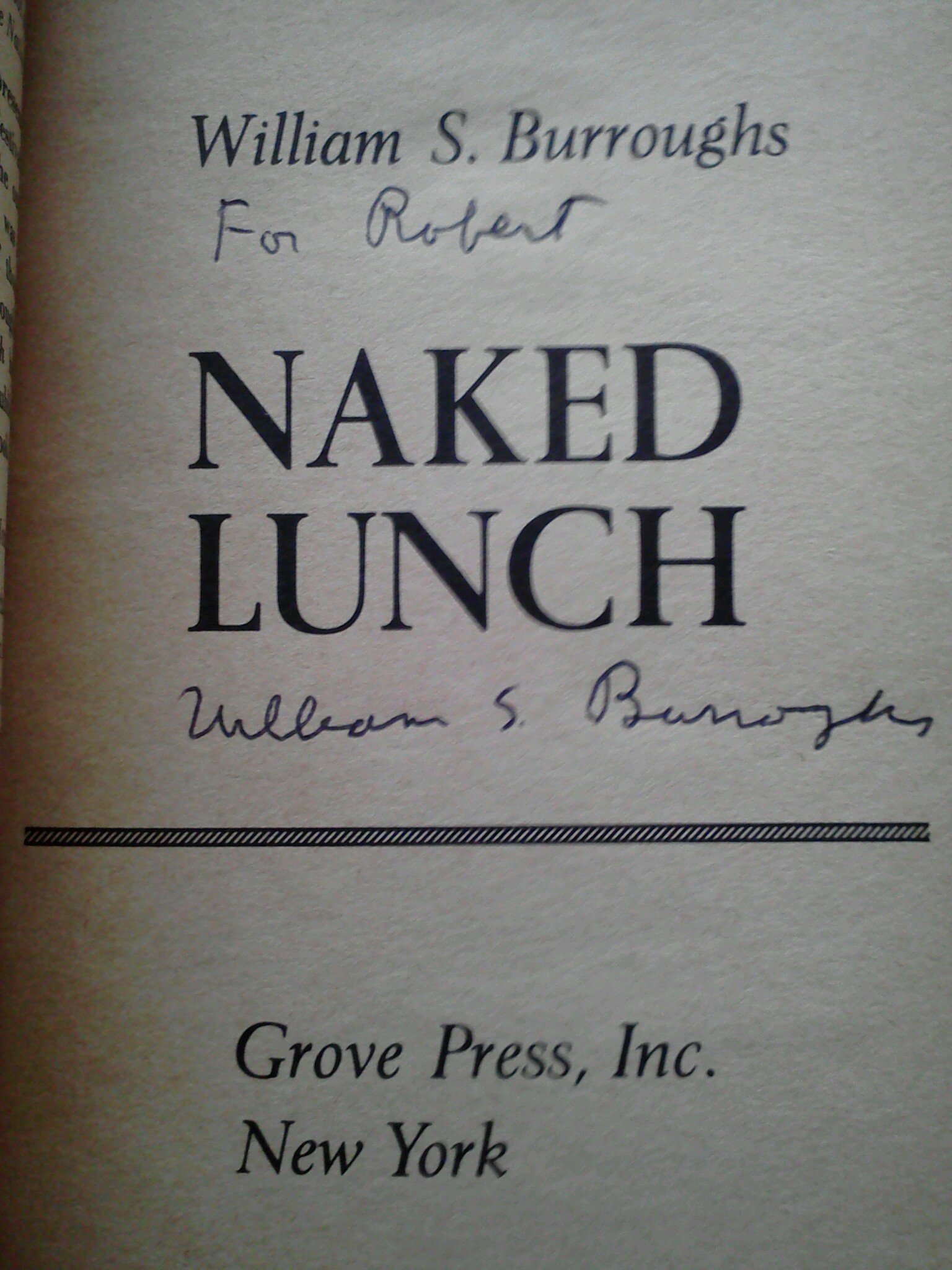
I instantly said yes, though to be honest I had never read any of Burroughs's work, though I was famiar with his notorious reputation, and in fact that very week had read an interview in the "Village Voice" between him and Tennessee Williams, which piqued my interest even more.  So right after lunch I took the bus into nearby White Plains and scoured the two or three bookshops there for any Burroughs books. I found a used Grove Press paperback of "Naked Lunch" and headed back to campus, but there was no time to read it -- I had to be at Katy’s campus apartment for that early dinner. When I arrived at the apartment there were a handful of other students already there. Katie was in the tiny kitchen preparing dinner. There was a smell of quiche in the air.

I’ve never been fond of quiche, but I was willing to take one for the team in order to meet Burroughs. He hadn't shown up yet and a couple of the guys were watching a baseball game on the TV in the living room. "Turn that thing off, he's coming up the steps!" someone hissed. The TV was duly flicked off and I heard the doorbell ring, followed by a voice that was low and gruff, but with a certain elegance of diction, saying, "Got anything to drink?"

Before he'd even entered the room, our hostess brightly said, "We have a really excellent bottle of wine..." 


"No, I mean the hard stuff. Scotch, whisky."

Katie turned from the door and rushed into the living room, panic-stricken. She grabbed one of the guys and frantically told him, "He wants real the hard stuff, go out and find someone on the block who's got Scotch or something like that.”

The designated booze-hunter scooted out the door as Burroughs walked in. He wore a gray three-piece suit and carried a briefcase and looked for all the world like at cross between the vice-president of a small Midwestern bank and a rather large lizard languidly sunning himself on a rock. He was followed by a much younger male companion who was wearing a beige jumpsuit and resembled a young David Bowie Burroughs sat on the cheap student sofa across from me and Bowie sat on the floor in the corner in a kind of yoga position. 

Nobody knew what to say -- what can you say to a legend? -- but fortunately the bottle of Scotch arrived with admirable speed. Someone fetched a tall glass from the kitchen and brought it to Burroughs; he filled the glass to the top and he polished it off neat in one long swig. I was astonished.

Nobody else but Burroughs drank the Scotch -- that was his bottle. The quiche was handed out on paper plates which we balanced on our knees as we attempted some small talk. Our thoughtful hostess tried to bring Bowie into the conversation by asking, 

"So, um, what do you do?"


He suddenly looked up and said, "Oh! I write," then went back into sleep mode.

Someone asked Burroughs what he was working on. "Oh, this movie script, but I can't seem to get it right,” he said.  

Since I was then studying in the school's Film Department, I saw a conversational opportunity.

"But why be so Hollywooden old-fashioned and start with a script?"  I said.  "Why not be just as experimental with film as you are in your books" -- none of which I'd actually read --" and improvise as you go along, letting the images tell the story....or do without a story entirely?" 

Burroughs looked at me as if he was that Midwestern banker whom I'd just asked for a large loan with zero collateral. "No, no, no" he growled, "you gotta have a script, you gotta have a story, the producers won't give you any money without a script, don't you know anything!" At that time I was unaware that years earlier Burroughs had indeed made some very avant-garde films of the kind I was talking about; perhaps he now wanted to play with the big boys.  


More desultory small talk ensued, and finally someone had the temerity to ask Burroughs "how" he wrote "Naked Lunch." The Scotch must have loosened him up, because he launched into an absorbing account of how he'd written mountains of material over many years -- stories, sketches, anecdotes, hallucinations he'd had while stoned -- but never knew what to do with them. Then, sometime in the late Fifties, Allen Ginsberg told Burroughs he could get him a book deal if he had a manuscript ready in about a week or so. 


"A week!" Burroughs said. "I've got thousands of pages in no particular order and you want me to assemble them into a book in a week!"


Ginsberg had said, "Yes, Bill -- I know you can do it."


So Burroughs set about stitching all those disparate prose and out of it emerged "Naked Lunch."  The very book Burroughs was now going to read from in a few minutes before a packed crowd in the Neuberger Museum (also built of brown bricks).  I couldn’t help but wonder if the book would be as dour as the man himself.


Dinner completed, we headed out the door where it was just starting to get dark. As we walked along the path to the museum, I gamely peppered Burroughs with questions: "Mr. Burroughs, I read that interview Tennessee Williams did with you in the "Voice" this week. It was all talk about drugs. Don't writers of the stature of you and Williams have anything else to talk about?"  Yes, I was that jejune then.


Burroughs glowered at me as we walked. "Of course we did! We talked for nearly six hours about everything you can imagine! The editors chose to print just the drug stuff.  Don't you know how newspapers work?"


I gulped and acknowledged my increasingly apparent ignorance. But I tried again. 'Mr. Burroughs, I read you live down on the Bowery. Isn't that kind of...uh, dangerous?"


He shook his head. "Nah, it's just a lot of bums and winos. They're harmless.”


My education complete, we entered the building. Every seat was taken, standing room only. I suddenly remembered the copy of "Naked Lunch" I had in my bag. I asked Burroughs to sign it and he wrote on the title page above the title, "For Robert," and underneath the title, in his scraggly signature, "William S. Burroughs."  


I couldn't find a seat, but what the hell -- I'd had the best seat in the house just twenty minutes ago. I crouched in an aisle as Burroughs read some of the wildest, funniest passages from "Naked Lunch," doing all the voices -- Dr. Benway, AJ, Clem, O’Brien -- emerging from his Midwestern banker demeanor as an actor of considerable gifts and acute comic timing:


“Get me a new scalpel; this one's got no edge to it!”


He thrusts a red fist at her. The doctor reels back and flattens against the wall, a bloody scalpel clutched in one hand. The patient slides off the operating table spilling intestines across the floor.


Dr. Benway sweeps instruments, cocaine and morphine into his satchel.


“Sew her up, I can't be expected to work under such conditions!”


Afterwards, Burroughs took some questions from the audience. I only recall one (and I wasn‘t the person who asked it):  "Mr. Burroughs, a friend of mine is seriously thinking of getting into heroin. What would you advise them?"


I was sure Burroughs would give a withering reply, but he just calmly said, "I can't tell anyone whether to use or not use junk. It's his life, he has to make his own decisions."


That seemed to wrap up the evening. The crowd dispersed.  I headed to my oppressively silent dorm room,, sat at the desk, and began to read the first pages of "Naked Lunch."  The tone of the book immediately cut through me like an icy cold knife, the blade dipped in an arctic nihilism that was no pose but the real thing.  This guy really means it.  Yet as I read on, that knife turned out to be not the lethal scalpel of Dr. Benway, but one that cut away the polite conventions and banalities of everyday life to release an oddly healing balm of unbridled, utterly anarchic laughter.  Suddenly my room,, empty except for me, was filled with the raucous voices of Burroughs’ uniquely carnivalesque paranoid imagination.  For the first time I became conscious of the enormous gulf between a person’s outward appearance and the astonishing stuff that might go on in their mind.


The next day I heard that some of the guys from the dinner had gotten into a car with Burroughs and smoked some pot on the way to the Hilltop Bar, where they drank and told stories into the night.


And I'd missed it.  I'd never used any kind of drugs during my three years at the college...but I think I might have smoked a joint so I'd be able to say years later, "I got high with William S. Burroughs."  It would have made a hell of a story.